
Finasteride for Hair Loss
Does It Work, Is It Safe, and Why We Don’t Use It
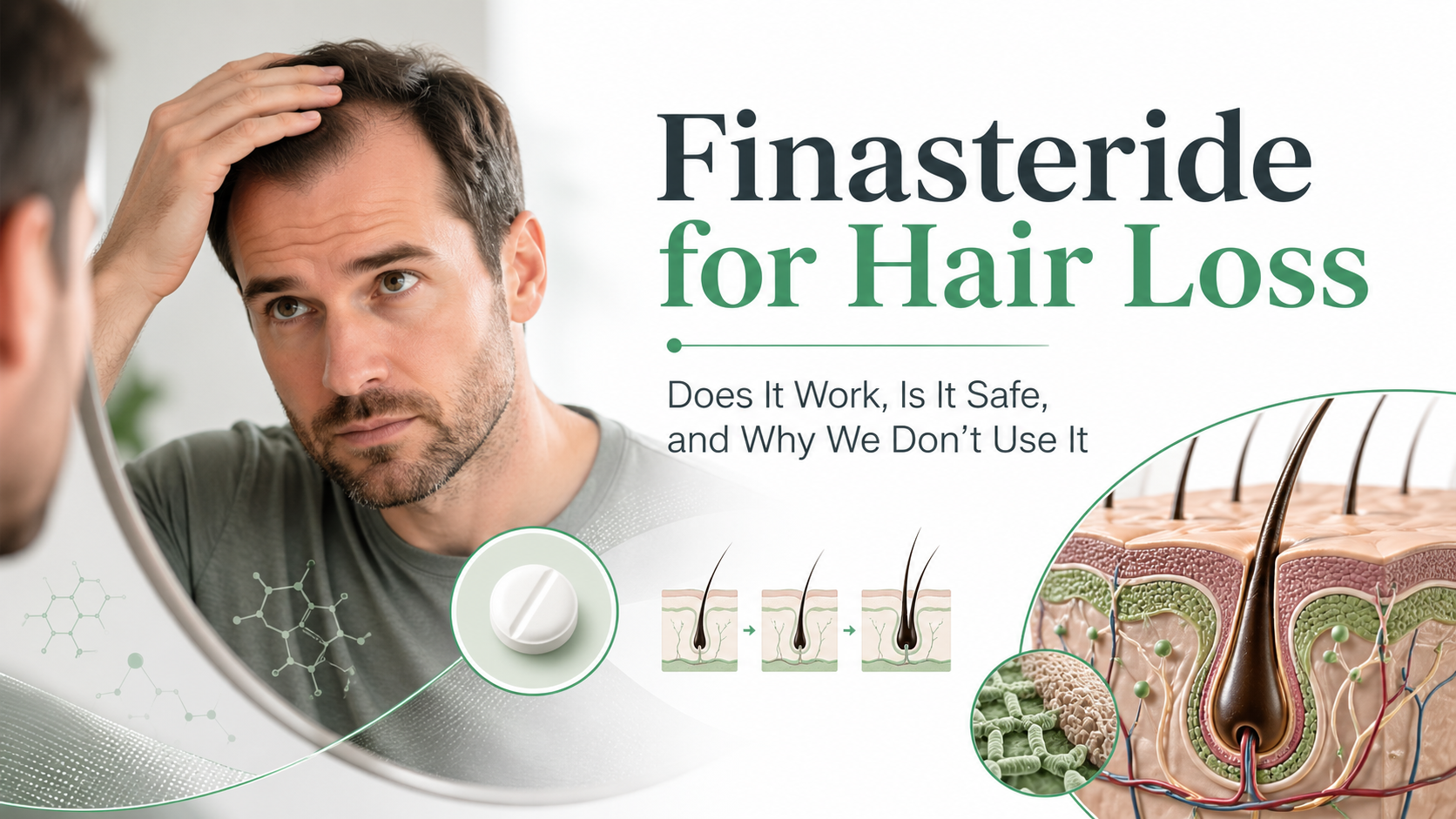
If you’ve been anywhere near hair-loss internet, you’ve seen finasteride treated like the answer. Some people swear it saved their hair. Some people swear it wrecked them. Most people are just trying to make a decision without getting sucked into either cult.
Here’s the truth: finasteride did improve or slow male pattern hair loss for some men in clinical trials, but it does not fix the underlying reason the hair became vulnerable in the first place. It’s a pathway-blocker — not a root-cause solution.
And that’s why we don’t build our program on it.
Quick Summary (for people who skim)
Finasteride (Propecia 1mg) is FDA-approved for male pattern hair loss and has evidence of increased hair counts vs placebo in controlled trials.
It works by inhibiting
Type II 5-alpha reductase (with much weaker action on Type I), reducing DHT signaling.
But DHT blocking is not the same thing as fixing why the follicle is miniaturizing — and stopping treatment typically means losing the benefit over time.
FAQ: Finasteride and Male Pattern Baldness
1) What is finasteride and why was it approved for hair loss?
Finasteride is a 5-alpha reductase inhibitor. It reduces the conversion of testosterone into dihydrotestosterone (DHT), a hormone involved in male pattern hair loss.
Propecia (finasteride 1mg) is FDA-approved for male pattern hair loss, with brand approval dating to December 19, 1997.
2) Does finasteride work for hair loss?
In the classic 1–2 year clinical trials (men ages 18–41), finasteride increased hair counts vs placebo and slowed progression of loss.
A 2010 systematic review (Arch Dermatol/JAMA Dermatology listing) also concluded finasteride outperformed placebo across common measures (hair counts, global photographs, patient/investigator assessment) in both short-term and longer-term follow-up.
But here’s the part people miss: “works” usually means slows loss / modest regrowth, not “restores your teenage density forever.” Even StatPearls notes that in androgenetic alopecia, finasteride slows loss but doesn’t necessarily halt it completely.
3) Why do you say finasteride doesn’t address the root cause?
Because it’s doing one narrow thing: altering DHT conversion — and that’s not the same thing as fixing the biological environment that made the follicles shrink.
The FDA label itself describes finasteride’s mechanism as preferential Type II inhibition, and explains Type I and Type II are different and distributed differently across tissues.
Translation: It’s a lever, not the whole machine.
Hair loss is a symptom. The question is: symptom of what? If someone ignores inflammation, micronutrient issues, thyroid/metabolic signaling, stress physiology, scalp environment, etc., they’re treating the “smoke,” not the fire.
4) “It only works on one pathway” — what does that mean?
Finasteride is selective. It preferentially inhibits Type II 5-alpha reductase with far less activity on Type I.
Dutasteride, by contrast, inhibits Type I and Type II and suppresses serum DHT more strongly (StatPearls describes “near-complete suppression” and cites >90% serum DHT reduction vs ~70% for finasteride).
So yes — “block DHT” is not one uniform thing. Not all drugs hit the same targets.
5) What about half-life? Does finasteride wear off quickly?
The Propecia prescribing information includes pharmacokinetics: a mean terminal plasma half-life around 5–6 hours in men 18–60 (longer in older men), and ~4-5 hours in certain dosing data.
This matters because a short half-life often correlates with the “you stop → it fades” reality for many people.
6) If finasteride works, why don’t you use it in your program?
Because our approach is built around root cause and biological repair, not “hold back the tide with a single chemical lever.”
Also, patients are often sold a fantasy: “Take fin, you’re done.”
But even the Propecia label states withdrawal leads to reversal of effect within 12 months.
So the real choice is usually: commit long-term, accept tradeoffs, and hope you’re a strong responder — or fix what’s driving the loss upstream and build something sustainable.
7) What are the known side effects in trials?
From the Propecia label, the most common adverse reactions (≥1% and greater than placebo) include decreased libido, erectile dysfunction, and ejaculation disorder.
The label also provides year-1 rates and notes that the incidence of these adverse experiences decreased by year five in long-term treatment data.
A systematic review/meta-analysis of randomized placebo-controlled trials (4,495 subjects) reported an increased relative risk of sexual dysfunction for 5-alpha reductase inhibitors overall, including finasteride 1mg.
8) What about depression, anxiety, or suicidal thoughts?
This has become a major point of concern. In 2025, Reuters reported the European Medicines Agency confirmed suicidal thoughts as a side effect of finasteride (noting the frequency couldn’t be determined from available data) and that patient card warnings would be added for 1mg products.
This doesn’t mean “everyone will experience this.” It means it’s serious enough that regulators are explicitly highlighting it, and it should be part of informed decision-making.
9) Is “Post-Finasteride Syndrome” real?
You’ll see fierce arguments about PFS online. Here’s the most honest, responsible stance:
- Persistent symptoms are reported by some people.
- The medical community continues to debate causality, mechanisms, and frequency.
- Regardless of what label someone uses, a patient’s symptoms are real to them, and they deserve careful evaluation.
If you’re considering finasteride, the rational move is not panic or denial — it’s informed consent and a clear plan with a clinician.
10) If someone starts finasteride, how long until they see results?
The Propecia label states daily use for three months or more may be needed before benefit is observed.
Many people won’t judge fairly until later.
11) Do you have to take finasteride forever?
For most men, continuation is required to sustain benefit. The label states that discontinuation leads to reversal of effect within 12 months.
So if someone’s “plan” is: “I’ll take it for a bit then stop” — they should understand that’s usually not how this game works.
12) So what should someone do instead of chasing a “miracle drug”?
This is the part we wish more people understood:
The modern approach is not “what pill fixes hair?”
It’s:
- Why is your hair loss accelerating now?
- What is the scalp environment doing?
- What does your bloodwork suggest about inflammation, deficiencies, metabolic stress, hormones, and recovery capacity?
- What can we correct so follicles can actually function again?
That’s root cause. That’s what medicine has evolved toward — and ironically, hair-loss culture often hasn’t.
If you would like to talk about your personal situation during a free consultation, you can schedule a time online below.
Recent Articles From Our Blog